Saturday evening, December 1, we had a salad with supper, and 100% of it was picked about an hour before the meal in the Givler Garden. It had purple lettuce, mustard and radish leaves, diacon radishes, sliced celeriac root, and carrots.
So how do you get a fresh home-grown garden salad in December? The truth is that it's not hard...
1. Plan for it. In March, after I'd planted my early seeds, I made two piles with what was left, one for a late-spring/early summer planting and one for a late summer/early fall sowing. Crops that love heat were in the summer pile, and crops that tolerate cold well were in the fall pile. If you want to put out seeds late in the season, you must already have them in hand, as those pretty little seed packets are nowhere to be found for sale in August and September.
2. Re-sow your garden early and often. Have a hole where spinach didn't germinate? Pop in some onions, or toss in some marigold seeds. Harvest all your bush beans or radishes? Put in new seeds...preferably something from a different plant family so they will be sucking a different mix of nutrients from the soil. Crop rotation also helps keep the insect pests baffled. Don't forget to add compost when you re-plant. Leaving chunks of the garden empty doesn't make sense to me. If you want to give it a break and improve the soil, plant a cover crop that you'll chop back into the soil before it goes to seed.
3. Know how much time you have. If your expected first frost is October 31, and it's August 31, then whatever you plant needs to mature within 60 days, or you need to be able to eat it young and immature. It's also a good idea to plant cold-hardy vegetables. I've had success with kohl rabi, collards, arugula, mustard greens, radishes, swiss chard, carrots, lettuce, and celeriac.
4. Fool the frost. We've been very lucky here in Central Virginia this year with a mild winter. The first frost arrived on-time, but we've only had a couple heavy frosts. I think the coldest overnight low so far has been 26 degrees. If your forecast calls for a serious overnight cold spell, don't fret...just cover those plants. A clear plastic sheet, secured on either side of the row, does the trick for me.
Leaves piled over the live plants works too. Using both of those methods, you'll need to go uncover them the next morning. Other, more permanent ways to extend the season include hoop houses and cold frames. I haven't tried those, since the greenhouse meets most of my winter gardening needs. However, a great book about extending the harvest using those and other methods is The Year Round Vegetable Gardener by Niki Jabbour. I found it at my local library, and it's full of good tips and ideas. Niki's blog about gardening in Nova Scotia is a good read as well. Clearly, if she can have fresh salads during the snowy Canadian winter, mere mortals like me can pull it off in balmy Virginia.
Advice needed...I have a ton of is collard greens, and I need a new recipe. We've got the deep-south, cooked with smoky pig parts and vinegar style collard greens down pat. Anyone have another tasty way to cook collards?
Monday, December 3, 2012
Tuesday, November 20, 2012
Leaves and Leftovers
This weekend was clean-up day for the garden. Plants killed by frost were ripped out and added to the compost. Tomato stakes were pulled and put away for the winter.
After all the removal, we still have a lot of edibles available. The list includes green onions, beets, red leaf lettuce, swiss chard, celeriac, arugula, collards, New Zealand spinach, kohl rabi, mustard greens, and radishes. These garden leftovers should make some tasty stir-fry and salads over the next few weeks.
Everything left has survived a couple hard frosts. These guys are tough and hardy. Once the garden inventory was complete, it was time to tackle leaves. Everyone helped, and placed the leaf harvest in the garden.
I spread the leaves in the troughs between the seedbeds, and stepped on them to compact them in and keep them from blowing around too much. My hope is that they will decompose some over the winter, turning into leaf mold that I can till into the soil. This was the first raking. There will be more leaves.
After all the removal, we still have a lot of edibles available. The list includes green onions, beets, red leaf lettuce, swiss chard, celeriac, arugula, collards, New Zealand spinach, kohl rabi, mustard greens, and radishes. These garden leftovers should make some tasty stir-fry and salads over the next few weeks.
Everything left has survived a couple hard frosts. These guys are tough and hardy. Once the garden inventory was complete, it was time to tackle leaves. Everyone helped, and placed the leaf harvest in the garden.
I spread the leaves in the troughs between the seedbeds, and stepped on them to compact them in and keep them from blowing around too much. My hope is that they will decompose some over the winter, turning into leaf mold that I can till into the soil. This was the first raking. There will be more leaves.
Thursday, November 8, 2012
Frost
Planting in late summer for an autumn harvest is a great way to extend the gardening season and keep putting tasty stuff on the supper table. Here in Central Virginia, first frost generally hits at the end of October, so as long as you can count backwards from that average frost date, and only put in things that can mature in time, you can squeeze in a second growing season.
In this recent harvest, the green beans and the sugar snap peas are from plants grown from seed that went in the ground in late August. I planted about a fourth of the garden with relay crops then, and put down clover as a cover crop a little later.
Clover is in the foreground. Starting on the right and working to the left, you can see New Zealand spinach, collard greens, arugula, snap peas, and my Kentucky Wonder bean tepee, which produced all summer and fall. Green beans are killed by frost. Peas are hardier, as are the cabbage family greens like collards and mustard greens. Earlier this week, a hard frost hit.
This was the first frost we'd had. It was 29 degrees Fahrenheit that morning.
It was cold enough for ice to form in the top of these buckets of water.
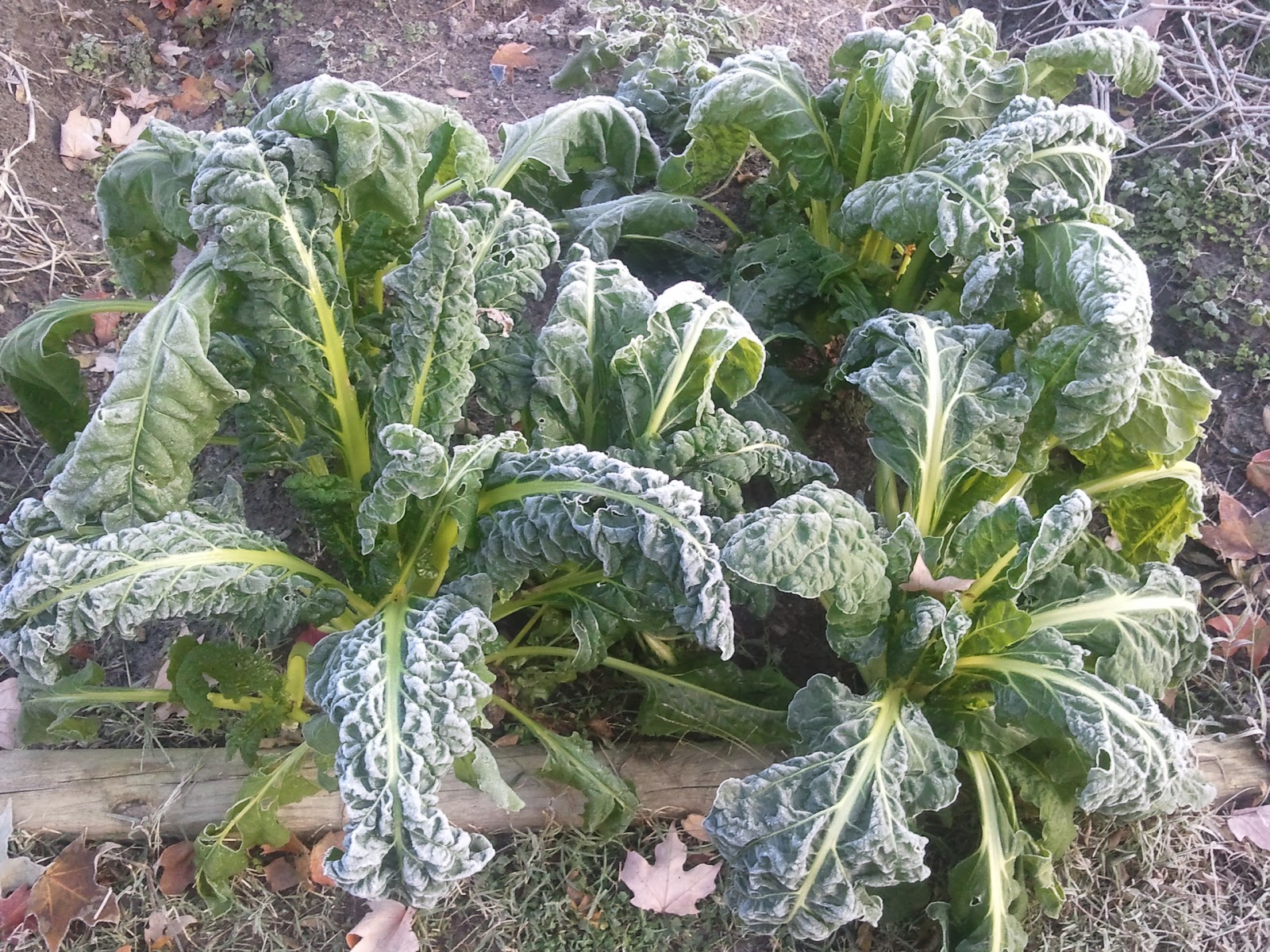
These collards look frozen, but they defrosted and perked right back up. The most important thing is to not pick anything while it is frosty, or you'll wind up with a pile of goo in your basket. Let them unthaw, and then pick. Interestingly, frost exposure generally alters the flavor of most vegetables for the good. Root crops get sweeter, and leafy greens get tastier.
Our Swiss Chard, another August planting, appears totally defeated by the frost. However, just like the collards, they warmed up and are doing just fine. Chard is extremely cold hardy. I've read that it can survive in snow. Perhaps we'll find out first-hand.
Clover is in the foreground. Starting on the right and working to the left, you can see New Zealand spinach, collard greens, arugula, snap peas, and my Kentucky Wonder bean tepee, which produced all summer and fall. Green beans are killed by frost. Peas are hardier, as are the cabbage family greens like collards and mustard greens. Earlier this week, a hard frost hit.
This was the first frost we'd had. It was 29 degrees Fahrenheit that morning.
It was cold enough for ice to form in the top of these buckets of water.
These collards look frozen, but they defrosted and perked right back up. The most important thing is to not pick anything while it is frosty, or you'll wind up with a pile of goo in your basket. Let them unthaw, and then pick. Interestingly, frost exposure generally alters the flavor of most vegetables for the good. Root crops get sweeter, and leafy greens get tastier.
Our Swiss Chard, another August planting, appears totally defeated by the frost. However, just like the collards, they warmed up and are doing just fine. Chard is extremely cold hardy. I've read that it can survive in snow. Perhaps we'll find out first-hand.
Friday, October 26, 2012
What's in your wok?
The area is abuzz with talk of the impending landfall of Hurricane Sandy, a.k.a. The Frankenstorm. We actually could really use some rain, just not the deluge that a tropical storm will bring. I'm also not looking forward to high winds.
Oh well. Wok on!
Tuesday, October 9, 2012
Surprises and Disappointments
For me, one of the coolest things about the third year of gardening the same ground and using compost I make myself is the growth of volunteer plants. Vegetables that I did not plant appear like magic in the garden. No, I don't think the gnomes are doing it. Here's what happens... tomatoes, cucumbers, etc that rot on the vine get tossed in the compost or fall to the ground and get mixed into the soil. In the spring, after the compost has been spread and the garden tilled, seeds from those rotten veggies that did not decompose sometimes germinate. This year 4 or 5 red cherry tomato plants grew as volunteers, and this fall they have been producing fruit heavily.
Now, volunteer plants popping up are normal in a garden. For me, they are a pleasant surprise. An even bigger surprise is when a volunteer vegetable plant pops up and it's something that you have NEVER grown. This happened to me this year, and I discovered it recently while cleaning out a seedbed where I'd grown cucumbers. Nestled in there was a vine with these odd bluish-green pods on it. Inside each pod was what looked like a green cherry tomato. Here's a picture...
The mystery fruit is on the right. The pods are paper-thin, and on the far bottom right you can see what the inside fruit looks like. Have you guessed what this is yet? These are tomatillos, also known as ground cherries. They taste similar to a tomato...a different flavor, a little less sweet, but in the same ballpark.
The conundrum is this - How did tomatillo seed get into my garden? The easiest answer is via bird poop, but I'll never know for sure. Maybe it was the gnomes.
So, in early summer I planted Connecticut Field Pumpkins as a relay crop after something else got harvested. They took off, sending vines all over the garden. A grand total of two pumpkins formed. The first one was harvested but some sort of bug was already in it and it rotted on our counter top. We had high hopes for the second pumpkin, but those hopes have been dashed...
This appears to be the work of a rabbit. Cute little bastards. I shake my fist at them, and think mean thoughts. I don't think I'll be planting pumpkins again. I'll probably go with butternut and acorn squash next year instead. I did not plant butternuts this year, and Angelia misses them.
What's your favorite winter squash?
Subscribe to:
Posts (Atom)